


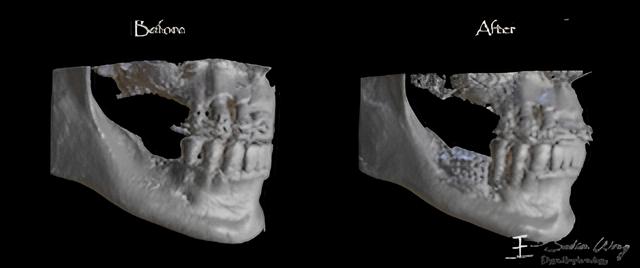
Custom Dental Implants: A New Era in Digital Implantology
For many years, dental implants were placed using a standard approach: a fixed-size screw inserted into the bone to replace a missing tooth.
Today, thanks to digital implantology, that concept has evolved. It is now possible to design fully customized implants that adapt to the exact shape of each patient’s bone. This allows for safer, less invasive treatments and eliminates the need for bone grafting. Even when bone loss is significant.
When is a custom dental implant recommended?
Not every patient needs one, but custom implants are especially useful when a conventional implant cannot be placed easily. The most common cases include:
1. Patients with moderate or severe bone loss
When bone is insufficient, a standard implant may compromise sensitive areas such as nerves or the maxillary sinuses or require additional grafting.
A custom implant is designed to match the shape of the available bone, reducing the need for extra surgeries and speeding up the treatment process.
2. Patients who had extractions many years ago
Over time, bone that is no longer functioning begins to shrink. This can create narrow spaces or irregular bone shapes.
A custom made implant adapts better to these areas, often without the need for grafting.
3. Patients with unusual or irregular bone anatomy
Some individuals present anatomical features that require a tailored design, such as:
-
- very large maxillary sinuses
- very thin bone walls
A custom design makes it possible to place the implant in the safest and most stable position.
4. Patients who want to avoid bone grafting
Bone grafts may involve additional surgeries and longer recovery periods.
Custom implants maximize the use of the patient’s existing bone, which can avoid extra procedures and, in some cases, allow for same-day teeth placement.
5. Patients with previous treatments that failed
If an implant was lost, if there was an infection, or if a bone defect remains, placing a conventional implant can be risky.
A custom implant adapts to the new bone condition and allows for safer planning.
6. Patients seeking faster, more functional results
In many cases, these implants allow teeth to be placed on the same day as surgery, reducing overall treatment time.
7. Patients with unstable removable dentures
Dentures that move, loosen, or don’t fit properly can improve significantly when supported by custom designed implants tailored to each specific case.
Bone Regeneration with Custom Titanium Mesh: Rebuilding Lost Bone
When a tooth is lost, the bone that once supported it begins to diminish. If this loss is mild, a conventional implant may still be possible. But when the loss is severe, there is no longer enough support.
For decades, this limited treatment options to removable prosthetics or complex procedures with unpredictable outcomes.
Today, thanks to digital implantology, there is a modern and precise alternative: custom titanium mesh, especially valuable for partially edentulous patients (those missing one or several teeth).
What are custom titanium meshes?
They are not generic or prefabricated products.
A custom titanium mesh is a thin, rigid structure designed digitally based on the patient’s CBCT scan.
The mesh:
- is manufactured 100% to the patient’s exact dimensions,
- adapts precisely to the bone defect,
- maintains the ideal space for bone to regenerate without collapsing,
- enables three-dimensional regeneration: height, width, and projection.
When are they used?
They are indicated when bone loss is so severe that a conventional implant cannot be placed. This occurs in situations such as:
- old extractions without replacement,
- infections that destroyed bone,
- advanced periodontal disease,
- trauma or fractures,
- failed previous implants,
- complex anatomies requiring reconstruction.In the past, these patients often depended on removable prosthetics.
Today, they can regain the lost bone and become candidates for fixed implants again.
How does the process work?
Regeneration with custom meshes follows a highly precise digital plan:
1. Diagnosis with 3D imaging
A CBCT scan measures the exact amount of missing bone and analyzes the full anatomy.
2. Digital design of the mesh
Using specialized software, the ideal shape of the regenerated bone is planned. The mesh is then fabricated based on that design.
3. Surgical placement
During surgery, the mesh is positioned over the defect and secured. Biomaterial is placed underneath to stimulate new bone formation.
4. Guided healing
The mesh acts as a “template” that preserves the ideal space while the bone grows. This phase typically takes 6 to 9 months.
5. Mesh removal and implant placement
Once the bone has regenerated properly, the mesh is removed and the implant is placed on a solid foundation.
What are the advantages?
- Total precision: designed according to the patient’s real defect.
- 3D regeneration: restores height, width, and contour.
- Stable structure: the mesh prevents collapse.
- Less inflammation and shorter surgical time: thanks to a fully customized design.
- Predictable outcomes: digital planning minimizes surprises.
- Ideal for “impossible” cases: large defects that once lacked solutions.
- Better aesthetics: proper bone volume allows for better implant positioning and more natural results.
Do all patients need a custom mesh?
No.
These meshes are used only when the bone defect is large or complex. The decision is made after evaluating:
- clinical examination,
- photographs,
- intraoral scans,
- CBCT imaging,
- full anatomical analysis. Rebuilding what was lost is now possibleCustom titanium meshes represent one of the most significant advances in modern implantology.Today, many patients who once had no other option than removable prosthetics can safely and precisely regenerate lost bone and once again become candidates for fixed implants— with aesthetic and functional results that were not possible decades ago.
This educational blog piece was provided by Wong Digital Dentistry, the only clinic in Costa Rica to perform bone generation using titanium meshes and to offer both traditional and fully customized dental implants, automatically adapted to each patients unique bone structure when required. Read more here.



 SIGN INTO YOUR ACCOUNT